2025

Razzie Cloud

2025–2026
Thumbnail of Razzie Cloud

A self-hosted platform for my own apps, with shared database provisioning and passkey authentication. Docker Swarm runs the services and Caddy handles HTTPS and routing.

It started in 2020 with a few apps hosted behind Razvhost: UUID server, Geoip server, Mediaserver, Razbox and Razproxy. Later I started learning Kubernetes and moved my apps to Raz-Stack, deployed via Helmfile and Helm, along with Nextcloud. I also wrote k8s-db-operator to provide databases and Redis namespaces to the services, which became the predecessor to database-broker.

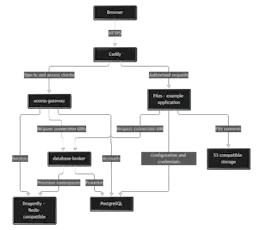
Eventually I wanted a simpler setup and simpler user management, so I created razzie-cloud. The two main services are database-broker and access-gateway: the broker provisions separate PostgreSQL databases and Dragonfly/Redis namespaces for each app, while the gateway handles passkey sign-in, device enrollment and user access. Apps request their database connection strings at startup and receive the signed-in user’s identity through Caddy, so they don’t have to implement their own account management.

Files uses both services: an S3 file manager with optional rclone encryption and public read-only share links. The infrastructure repo contains the Swarm stack, deployment tools and NixOS host configuration.

2023

0x40 Hues

2023
Thumbnail of 0x40 Hues

I’ve come across Kepstin’s amazing 0x40hues project and caught myself listening to it a lot. After finding community resource packs to try, it quickly became troublesome to configure and run them. This motivated me to fork the project and after a great deal of refactoring, it now supports loading many respacks and on-the-fly configuration.

Json2Go

2023–2024
Thumbnail of Json2Go

A webapp that helps you write Go client libraries for JSON web APIs. One of my experiments required building a database that included data from many third party JSON web APIs. The process of deserializing data into manually crafted Go structs quickly got exhausting, so I had to come up with a solution. Json2Go is by no means perfect (it only looks at the fields of the first item of a JSON array), but it gets the job done. You can input a JSON or a URL that returns a JSON. Field names are automatically converted into camel case, stripped of unsupported characters and correctly annotated with the original name. The resulting generated structure is formatted and uses syntax highlighting.

2022

k8s-db-operator

2022–2023
Thumbnail of k8s-db-operator

Kubernetes operator to provide access to shared PostgreSQL and Redis. It relies on the DatabaseClaim CRD, but unlike most other operators, this one only deploys Kubernetes secrets containing connection strings. Databases and Redis namespaces are not shared between dbclaims.

Raz-Stack

2022–2024
Thumbnail of Raz-Stack

A simple Kubernetes stack that hosted many of my own projects plus an email service (Dovecot + Postfix) and Nextcloud. The goal of this project was simplified deployment and cost saving, without horizontal autoscaling, though I picked K8s to be able to scale in the future. Many of the hosted webapps used a shared Redis (Kvrocks) instance with separate namespaces, thanks to k8s-db-operator. Deployment was done via Helmfile and Helm under the hood, but it was managed by a Makefile to make things even simpler.

RazChess

2022–2023
Thumbnail of RazChess

I’ve had a sudden spark of interest in chess as of late 2022 and decided to build my own web chess app with focus on simplicity and ease of use. Also I didn’t want to waste time convincing friends to register to [insert your favorite chess platform here]. With RazChess you just visit the website, copy the link of the session and pass it to the person you want to play with. As weeks passed I kept adding new features like chess puzzles (mate in two steps), Fischer random (chess960) game, included chess openings encyclopedia, custom games and the ability to download your matches as GIFs. There is also Redis support to restore active games after a restart.

2020

Beepboop

2020–2022
Thumbnail of Beepboop

A lightweight webapp framework that powers Razbox. Most of the original code was taken from Razlink, but it has heavily evolved since. The core mechanic consists of registering pages (which are mostly a template + handler bundle) and returning view objects from inside the handlers. There are some utilities for session handling, access management and logging too, but this library is not suitable for production use.

Geoip server

2020
Thumbnail of Geoip server

A web service that serves IP address geolocations in JSON format. Instead of relying on a local database it collects data from a (configurable) series of 3rd party providers, converting the results to a commom format. It supports provider fallbacks and caching.

Mediaserver

2020
Thumbnail of Mediaserver

A web service that fetches thumbnails with title from URLs. Originally planned to use it in a chat service to prevent the tracking of users by letting them download images directly.

Razbox

2020–2021
Thumbnail of Razbox

Super simple cloud file storage with almost zero configuration - powered by Beepboop Razbox stores all configuration and metadata in JSON files on the local filesystem and doesn’t rely on a relational database (though it has opt-in support for Redis caching). Each folder can contain a .razbox file (which can be generated by included tools) and the content is ready to be served. Read and write access to these folders can rely on separate passwords, so you can share read access only if you want. Subfolders are also supported and they inherit the read/write passwords, unless a .razbox file is generated for them. Uploaded files can have an arbitrary number of tags that allow filtering. Thumbnails are generated for media files (using ffmpeg for videos!), which are visible in gallery view. Some archive formats are also supported for read-only browsing. Individual files can be shared publicly, this making them readable without any password.

Razvhost

2020–2022
Thumbnail of Razvhost

Virtual hosting/reverse proxy with TLS termination and automatic certificate management. It supports proxying, file/directory serving, redirection, accessing SFTP or S3 buckets, hosting PHP projects or even tailing log files. The configuration is loaded from a single file that contains simple hostname -> target rules, where even templates are supported (check readme in repo). Changes to the config files are detected and applied during runtime. It can even watch Docker containers with VIRTUAL_HOST and VIRTUAL_PORT environment variables and direct traffic to them (though it would’ve been better to check labels instead, but it didn’t cross my mind at the time).

S3proxy

2020
Thumbnail of S3proxy

A super simple S3 proxy server that obfuscates file content before transmitting the request to the target. Obfuscation is done via a lookup table which is generated from a user provided key. Only signature v2 authentication is supported.

UUID server

2020
Thumbnail of UUID server

A http server that serves random (version4) UUIDs. It uses my hybrid pseudo- and true random generator library which periodically takes seeds from random.org and uses them to generate pseudo-random UUIDs fast.

2019

2018

RazTalk

2018
Thumbnail of RazTalk

A simple lobby/channel based registration-free webchat. Implemented using NancyFX + Razor + SignalR stack and relies on RazTools to support dynamic loading of bot libraries during runtime. The repo contains (outdated) bot implementations for CleverBot, Giphy, Imgur and Reddit. There is also a standalone desktop client, which is just a wrapper around the web interface.

2015

Personal website

2015–2024
Thumbnail of Personal website
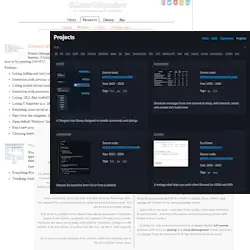
  • 2024 version

    Completely rewritten everything again using Go + PicoCSS + HTMX stack, featuring static site building with Github Actions. It supports light and dark themes (based on user preferences reported by the browser) and uses HTMX boosted page loads and loading spinner. Content is stored in a main content.yaml and individual project yaml files, everything else is in HTML templates.

  • 2019 version

    Everything completely rewritten in Go. Data was still stored in XML files initially, but later all the content (including resume) was moved to a single yaml file, which was periodically updated directly from the repository.

  • 2018 version

    Implemented in C# using NancyFX and a brand new design. It used Github API to list my latest open-source interests and contributions. Project data was stored in XML.

  • 2015 version

    The site made use of user friendly URLs (thanks to Apache web server’s mod_rewrite) and loaded pages dynamically via jQuery’s AJAX API. A server side PHP script automatically parsed the static HTML pages for sections, which could then be accessed individually by the user. It wasn’t very CPU friendly, but made it easy for me to add new content to the page without using a database. Later my Twitter feed was integrated as a news feed, using OAuth and Twitter’s API.

2007

Flyff fansite

2007–2010
Thumbnail of Flyff fansite

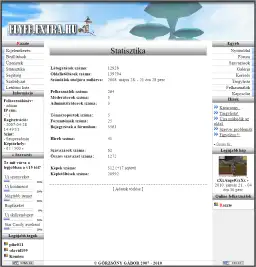
Flyff.extra.hu was a hungarian fan site of Flyff (Fly For Fun) online game. During the 3-4 years of its existence I developed more and more new features to make it a fully functional web portal. It was very interesting to see it slowly getting attention. Members started generating content in the forms of forum entries, polls, screenshots and news for the home page. The site even had a few moderators and admins. In 2010 extra.hu decided to close its free hosting service and the site went offline. I could have moved it to a different(even paid) hosting service, but most members and I have already lost interest in the game.

×